Motion Graphics
Ad Creative Systems
Media buyers don't need one perfect ad. They need enough genuinely different attempts to find out which angle works, and then more of whatever wins. We build ad creative as a system: hooks, bodies and calls to action produced as interchangeable modules, exported in every placement ratio, and named so a variant's performance in your ads manager traces back to a specific creative decision.
- Media buyers whose account is stuck because creative production is slower than the testing cycle
- Growth teams running paid social with one video that fatigued three weeks ago
- SaaS and e-commerce brands who need to test angles, not just colours and copy
- Founders about to spend their first real ad budget who want more than one shot at it
Creative is the variable, and most teams can only change it slowly
Targeting on the big paid-social platforms has been getting more automated for years. The levers a buyer still genuinely controls are budget, offer and creative — and of those, creative is the one that decides whether an ad set ever gets out of the learning phase. Which is awkward, because creative is also the slowest thing in the account. A typical cycle looks like this: commission a video, wait a week or two, launch it, watch it fatigue, commission another. Each round tests one idea, and by the time the data arrives the buyer has forgotten what they were actually asking. The fix is structural rather than creative. If a video is built as separable parts — the first three seconds, the demonstration in the middle, the closing ask — then testing a new hook against a proven body is an export, not a production. The system is what turns creative from a monthly delivery into something the account can iterate on.
What's included.
Every ad creative systems engagement covers all four of these — they are the work, not upsells.
A modular build: hooks, bodies, CTAs and end frames
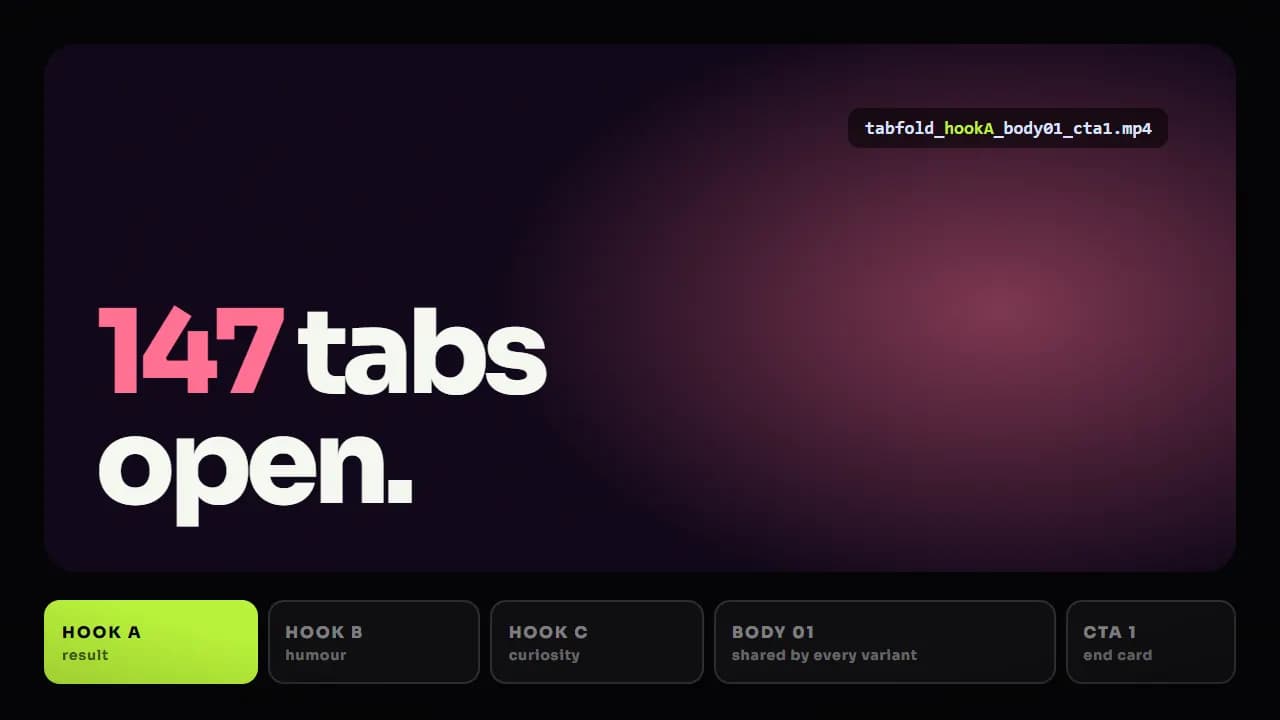
Every ad is constructed from separable segments rather than as one flattened timeline. The hook — the first two to three seconds — is its own module, as are the demonstration body, the offer or CTA, and the end frame. Because the segments are cut to interchange cleanly, a set of five variants is not five near-identical edits; it is a matrix you can recombine. Once a hook proves itself, pairing it with a different body is a re-export rather than a new brief.
Genuinely different angles, not five colourways
The single most common waste in ad testing is variants that differ cosmetically and therefore all perform the same. Before production we agree a written angle list where each variant argues something distinct — problem-first, outcome-first, comparison, objection-handling, social proof drawn only from material you can actually substantiate. That way a losing variant tells you an angle is wrong, which is information, instead of telling you that blue underperformed teal.
Every placement, exported to platform spec
The same creative goes out as 9:16 for Reels, Stories and TikTok, 4:5 and 1:1 for the feed, and 16:9 where a placement still requires it — each reframed with type re-set rather than centre-cropped from one master. Captions are burned in for sound-off viewing and supplied as sidecar files, and each variant ships with a still frame for placements that fall back to a static image.
Naming and a variant map your ads manager can read
Every file follows one convention that encodes the offer, hook, body, CTA and ratio, and the delivery includes a map of which module is in which file. This is the unglamorous part that makes the rest useful: without it, a buyer looking at a spend report six weeks later can see that variant four won but not what variant four actually said. With it, results roll straight back into the next batch.
See the work.
Style samples for this service — grouped by what they demonstrate, because that is how buyers actually choose.
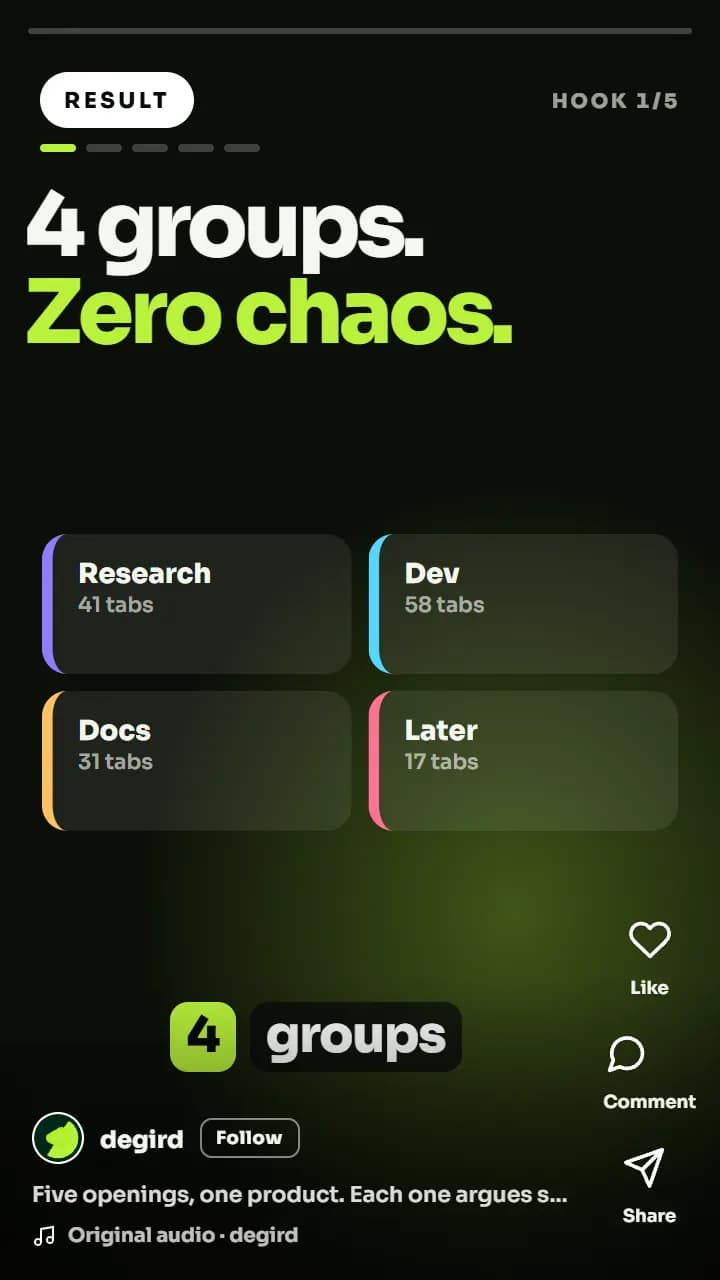
tabfold_hookA_body01_cta1.mp4tabfold_hookA_body01_cta2.mp4tabfold_hookA_body02_cta1.mp4tabfold_hookB_body01_cta1.mp4tabfold_hookB_body01_cta2.mp4tabfold_hookB_body02_cta1.mp4tabfold_hookC_body01_cta1.mp4tabfold_hookC_body01_cta2.mp4tabfold_hookC_body02_cta1.mp43 hooks × 3 body/CTA pairs = 9 variants from 5 cut modules · product_hook_body_cta
What you actually receive.
Resolutions, ratios, formats, and source files — stated up front rather than discovered at handover. Full delivery specification.
- Variant count
- 5 modular variations in Growth Bundle, 10 in Scale, up to 20 across a Full-Funnel engagement
- Module structure
- Hook (0–3s), body, CTA and end frame delivered as separate swappable segments
- Naming convention
- brand_offer_hook02_body01_cta03_9x16_v1 — offer, module IDs, ratio and version encoded in every filename
- Placement ratios
- 9:16 (1080×1920), 4:5 (1080×1350), 1:1 (1080×1080) and 16:9, each reframed and re-typeset
- Lengths
- 6s, 15s and 30s cuts of each winning combination, so one angle covers short and standard placements
- Delivery formats
- MP4 (H.264) at platform-compliant bitrates, burned-in captions plus .srt and .vtt sidecars
- Static companions
- A still frame per variant at 1080×1350 and 1200×628 for static and display placements
- Cadence
- Batch delivery on packages (10–14 days); on the monthly retainer a single new variant averages about 48 hours
How it gets made.
The sequence for this service specifically. How we work, in detail.
- 01
Angle and offer teardown
We look at what you are selling, what your existing ads have already said, and what your buyer says converts on calls. The output is a written angle list — one line per variant, each arguing something different — approved before production so the test is designed rather than assembled.
- 02
Module design and one built variant
One complete variant is produced first, end to end, establishing the visual system, caption style and pacing. You sign that off before the batch is built, because a note on the look at this stage costs one asset and the same note after the batch costs all of them.
- 03
Batch build and recombination
The remaining hooks, bodies and CTAs are produced against the approved system and assembled into the agreed combinations. Because the segments are built to interchange, additional pairings later cost an export rather than a shoot.
- 04
Placement pass and naming
Each variant is reframed for every ratio you buy, checked against the platform overlays so nothing critical sits under a caption bar or action rail, then exported and named to the convention with the variant map written alongside it.
- 05
Read the results, then iterate
Send back what the ads manager reports — spend, hold rate, cost per result per variant — and the next batch is built around whatever survived. This is the step that makes it a system instead of a delivery, and it is why most teams running ads continuously end up on the retainer.
Where we've done it.
Real clients, live products. Every one of these links to the finished work in the place it actually runs.
E-commerce · Cart Recovery
CartResQ
Making automated cart recovery feel like a revenue tool, not another marketing plugin
Read the case studySaaS · AI Email Marketing
EmailFunnelAI
Turning a prompt-to-funnel AI tool into a story people understand in 60 seconds
Read the case study Watch the videoWordPress · Image CDN & Performance
PixJet
Explaining server-side image optimization to people who just want a faster site
Read the case study Watch the videoHealthTech · Digital Prescriptions
CloudRx
An AI-animated promo that makes digital prescribing feel effortless for doctors
Read the case study Watch the videoWhat it costs.
Ad Creative Systems first appears in the Growth Bundle at $950, which includes 5 modular paid-social variations alongside the launch and brand assets, with a 10-day turnaround and unlimited revision rounds. The Scale Package at $1,600 doubles that to 10 variations, and the Full-Funnel Bundle from $2,900 covers up to 20 across a rolling 30-day engagement. Teams testing continuously usually switch to the monthly retainer, where a single new variant from the queue averages about 48 hours.
$950
Growth Bundle
A distinct brand look, built for scaling acquisition.
10-day turnaround · Unlimited revisions
$1,600
Scale Package
A full-funnel content push, all at once.
14-day turnaround · Unlimited revisions
From $2,900
Full-Funnel Bundle
One big everything-kit before you roll onto a retainer.
Rolling 30-day engagement · Unlimited revisions
Ad Creative Systems questions.
A batch of separate video ads gives you a set of finished files that can only be used as they are. A system gives you the same ads built from interchangeable parts — hooks, bodies, calls to action — plus a naming convention that ties each file back to the decisions inside it. The practical difference shows up in week three: when one hook outperforms the rest, pairing it with a different body is a re-export rather than a new commission. You are buying the ability to iterate, not just the assets.
Enough that the variants are arguing genuinely different things, which in practice means around five distinct angles rather than five cosmetic variations of one. Five is what the Growth Bundle includes, and it is a sensible first test for most accounts. Ten, as in the Scale Package, makes sense when you are testing two audiences or two offers at once. What does not work at any count is a set that differs only in colour or music — those variants tend to perform identically and tell you nothing.
We write everything that appears in the creative: the on-screen hook, the text carrying the argument, and the closing ask. Before production you approve a written angle list so the messaging strategy is agreed before anything is animated. Primary text and headlines in the ads manager are usually better written by whoever owns the account, so we supply the hook lines as plain text with the delivery for you to build those around.
That is the best possible starting point. Send the ads that ran, along with what the account reported — hold rate, cost per result, which ones fatigued fastest. We rebuild the winning angle as a proper module set so it can be extended, and design the new variants to test against it rather than beside it. Working from a proven angle is far cheaper than starting from a blank brief, because the expensive question of what to say has already been answered by your spend.
It depends which engagement you are on. Inside a package, the whole batch is produced together on the package's own clock — 10 days on Growth Bundle, 14 on Scale — because those are multi-asset kits rather than single files. If you need creative to keep pace with an account that is iterating weekly, the monthly retainer is the right structure: it runs one request at a time from your queue and a single ad variant typically comes back in about 48 hours.
MP4 (H.264) at platform-compliant bitrates, delivered in 9:16 at 1080×1920 for Reels, Stories and TikTok, 4:5 at 1080×1350 and 1:1 at 1080×1080 for feed placements, and 16:9 where a placement still needs it. Each ratio is reframed with type re-set rather than cropped from one master, and content is kept clear of the caption block and action rail each platform draws over the video. Captions are burned in and also supplied as .srt and .vtt files, with a still frame per variant for static placements.
No. We produce the creative and hand it over — you or your buyer keep the accounts, the budget and the targeting. That is deliberate: the delivery is organised so somebody else can run it well, with consistent file naming, a variant map, ratios split by folder, and hook lines supplied as text. If you already work with a media buyer, we are happy to take the reporting straight from them and build the next batch around what it says.
More on ownership, licensing, payment, and revisions in the full FAQ.
What clients say.
“Degird was great to work with. They understood what I wanted and delivered a clean, high-quality promo and walkthrough videos that matched my expectations. Communication was smooth, and the whole process was easy. I'd definitely recommend Degird.”
Ratul Hasan
“I had a fantastic experience with Degird! I worked with them to implement a Lottie animation for my application, and the results exceeded my expectations. The process was smooth, professional, and the team made everything easy to integrate. Highly recommend Degird for anyone looking to enhance their app with high-quality animations!”

SM Jony
Verified reviews, not cherry-picked quotes.
We'd rather send you to an independent review platform than write our own testimonials. See what clients say about working with Degird on Trustpilot.
Read Our Trustpilot ReviewsNeed ad creative systems?
Tell us what the video has to achieve and when you need it. We reply within one business day with a package or a scoped quote.
Start your project